


Community & families
Our community
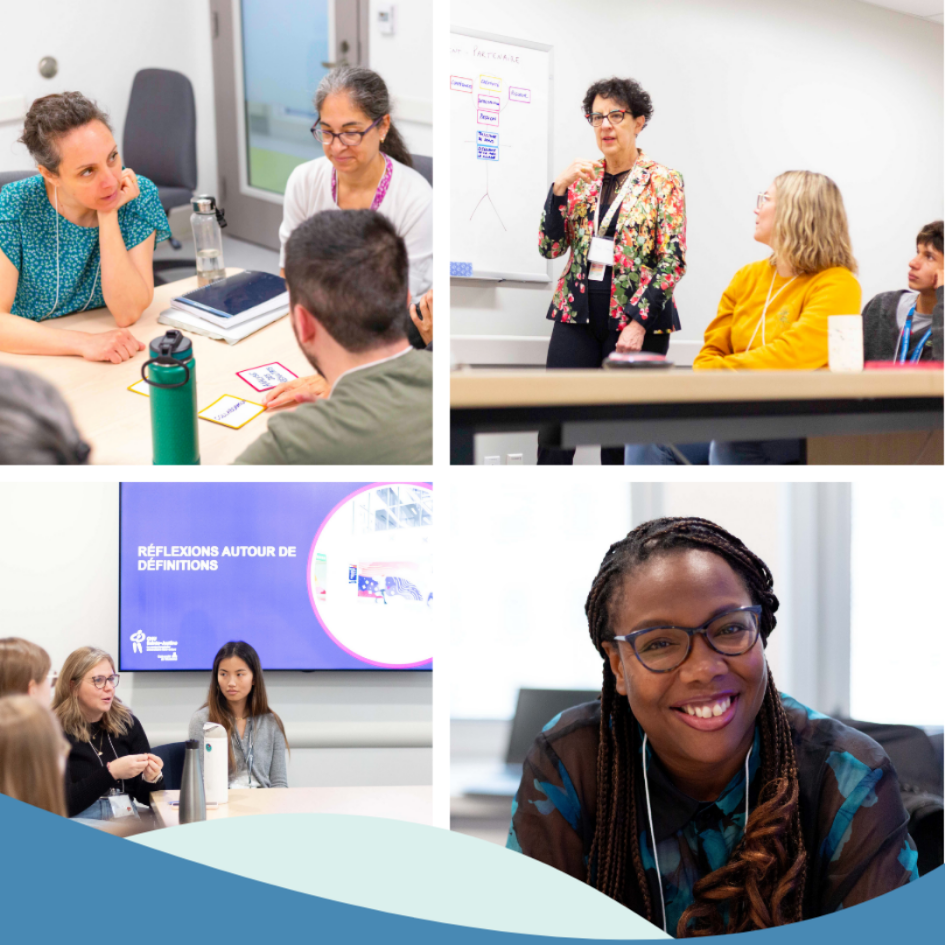
Providing truly individualized care means grounding paediatric precision health in the lived and unique experiences of each patient. The Precision Child Health Partnership is supported by a joint committee that brings together patients and families with lived experience to guide, inform and partner in our initiatives. This committee, known as the Patient and Family Advisory Committee, is led by Marie-France Langlet, Patient Partner and Senior Advisor, Bureau du partenariat patients-familles et soignants at CHU Sainte-Justine.


“Together, we are working to develop a world where children are true partners in care, confident in sharing their experiences. A world where they live fully, freed from the limits of their reality thanks to advances offering more precise diagnoses and treatments. Let’s dream together of a better future for the well-being of our children.”
Marie-France Langlet, CHU Sainte-Justine
What is Precision Child Health?
Precision child health is a holistic approach that is transforming how we care for children and youth. It relies on cutting-edge technologies, the latest scientific and medical advances, and genuine engagement with children and their families to better understand their lifestyles and environments. This approach enables us to deliver more individualized, effective care and gives every child the best chance to live life to their fullest potential.
Browse key terms for commonly used words and phrases used when talking about Precision Child Health.


Genomics
The study of genomics helps us understand how genes affect health, disease and traits. It leads to better treatments, by targeting issues at their source, like for a patient at CHU Sainte-Justine who received “prime editing,” a precision health approach that corrects mutation at its source.
Data
Safe data-sharing between SickKids and CHU Sainte-Justine helps researchers and clinicians work together to uncover patterns and accelerate scientific discovery. Data initiatives and infrastructure, like the UnIC project which leverages decades of hospital data to support research in perinatal and neurodevelopmental health enables secure, large-scale analysis essential to precision health.
Therapy
Understanding and investing in targeted, precision therapy ensures we can deliver the exact treatment each child needs based on their unique genes and biology, leading to faster recovery, fewer side effects, and better long-term results for children. Antisense Oligonucleotides (ASOs) are an example of a precision therapy that SickKids and CHU Sainte-Justine are exploring together to improve outcomes for children with rare diseases.
Read about the ASO Connect project.
Nutrition
Each child is unique in their own way. Diet and nutrition are part of a holistic approach to care that enables individualized care to improve health outcomes, like for Alexia who received individualized care through a ketogenic diet after being diagnosed with a rare genetic diagnosis, GLUT-1 deficiency.
Medication
Pharmacogenetics and pharmacokinetics help clinicians understand how each unique infant and child responds to a medication. Researchers at CHU Sainte-Justine and SickKids aim to use this information to tailor drug dosages to the genetic and developmental profiles of infants and children, like in the precision drug dosing project led by Drs. Lewis and Thibault.
Neurodevelopment
By studying epigenetic signatures in rare neurodevelopmental disorders (NDDs), this research uses long-read sequencing to improve early diagnosis and clarify gene-epigenome-phenotype links. It highlights how precision health can transform care for NDDs through predictive diagnostics and personalized interventions, offering new hope for affected children and their families.
Environment
Environment and social factors—like where a child lives or their family situation—shape their health. Understanding these factors helps clinicians deliver care that is truly unique to each child, like in this research that aims to support access to precision asthma medication.
Interested in joining the patient partners community?
About le Bureau du partenariat patients-familles-soignants
Fostering a culture of partnership at CHU Sainte-Justine is nothing new. For years, le Bureau du partenariat patients-familles-soignants has been actively working to embed these practices into patient care, continuous quality improvement, and in some cases, clinical research.

About SickKids Family Advisory Network
At SickKids, partnership is about engaging children and families, according to their preference, in an authentic way. This means working with patients and their families to bring their voices to the table, to learn from their experiences navigating care, and to seek their input in the design of our services and spaces, and in priority-setting and policy-making.